

Öffnet in einem neuen Tab
The end of Agile

Agile bashing

What was the guarantee of success for modern companies for almost decades is increasingly becoming a buzzword: agility or agile working. This article aims to explain where this swan song comes from and why we haven't even moved away from the dregs of agile transformation. And why there is still no way back.

Agile bashing

What is agile working?

Agility stands for flexibility, adaptability and effective customer relationships. Nothing more and nothing less. It is about creating corporate worlds that have something effective to offer in the face of growing complexity. And only in the complex. Because agile means: hypothesis – trial and error – validation and iteration. And unlimited flexibility for the entire organization.
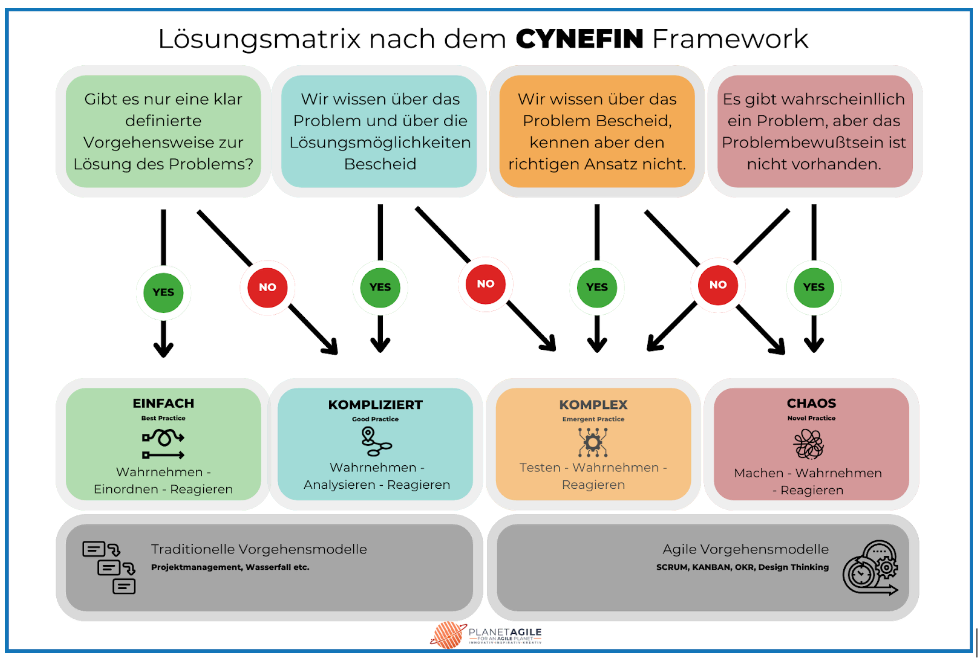
Solution matrix according to the CYNEFIN framework

To this end, the agile universe offers a set of tools and methods with the sole purpose of establishing and maintaining urgently needed communication structures. Within the company, with network partners and especially with the most important factor: the paying customers who make business success possible in the first place.

Anzeige

Where does the swan song for agile working methods come from?

When agile working is introduced in organizations, the reason is usually economic considerations, often resulting from the inability to find effective solutions. In most cases, the aim is to be faster, more efficient and achieve better results.

On the other hand, there are beliefs and convictions that seek to undermine the true spirit of agility.

Belief number 1: One more tool will save us.

The range of agile tools, methods and frameworks is constantly growing. And they all promise the same thing: Improved collaboration within the company and with the customer; shorter and more efficient communication channels; increased flexibility.

And since a single method doesn’t seem to create any real added value in this respect and doesn’t achieve much, if anything, it doesn’t stop there. Wherever you look, more and more tools are being used to supplement, or worse, cannibalize. According to the motto: „A lot helps a lot“

The result: floods of tickets instead of communication; ambiguous priorities; excessive demands.

Belief number 2: Agility is competence without leadership

It is a common misconception that agility can do without leadership. Agile teams in particular need guidance. So roles are being developed to replace the traditional manager. And there should not be just a few of them.

In turn, they are then also operationally active in the organization in addition to their agile role. This often leads to conflicting responsibilities.
In addition, agile roles are only trained rudimentarily, if at all. There is a lack of time, experience and the necessary skills.

Belief number 3: Agility needs modern office space

Open space, flex work, innovation hub or foosball table. Agile working does not come without changes to workspaces. These are designed to create communication spaces for teams. And not to make it more appealing for employees to return to the office.

What is much more important is to understand that it is about sharing. It’s about creating solutions in a complex space. This requires communication first and foremost.

No desire for even more agility

The result: The motivation to work agile decreases. Significantly. Because the added value is not clear. And the successes fail to materialize. Because using agility for the sake of agility and introducing everything imaginable has not led to any relief so far. On the contrary.

Anzeige

On the necessity of agile transformation

It is undisputed that the German economy is under massive pressure. Hoping for help from an ailing federal government or an economic turnaround will not be the lifeline. Companies must develop their own solutions to meet the challenges of digitalization, skills shortages and regulation.

Agile working is the only way currently known to us that enables corresponding solution scenarios.

How can the path to agility be paved?

We have all experienced first-hand that agility change is not an easy undertaking. Just like the fact that it is not a quick and radical change that can immediately cure all ailments. The only question is, how can it succeed?

1. creation of a communication culture instead of a tool culture

The measure of all things in agile is communication. And that takes place at eye level. People need to invest in a mutual exchange in order to create quick and simple solutions.

2. empowerment of role models

Whether SCRUM master or agile coach. These roles require expertise and experience. This requires time and support. Another factor where communication is essential.

3. take out the pressure

Turnover is a must, that’s a fact. But viewing agility as a sales driver and living it that way does not do justice to the true spirit of agile thinking. On the contrary: focusing on customer centricity and simple solutions will not lead directly to economic success, but only afterwards. And this is only possible through communication with each other and with customers.

4. putting people at the center

People have creative power and a solution-oriented approach. This needs to be encouraged. And this requires goal-oriented communication structures that ensure that solutions can be developed at all.

Conclusion and outlook for the future

Even if some people have the impression that agility is on the wane again, we can no longer avoid it. The fact is that agile working methods, new work or similar approaches are currently the only means of dealing with complexity that can and will have an impact. At least until we have found something else.

And it is still clearly recognizable that we have not even come close to the true agile spirit in our business world. In fact, we are only at the beginning. And in order to be able to overcome these and future challenges, we cannot avoid not only giving agility a second chance at its foundations, but also internalizing the essential cornerstones:

  • Communication with each other, with customers and colleagues. And not tool-driven, please, but in real time.
  • Customer centricity instead of customer satisfaction management. Focus on the user.
  • Trust and responsibility. Everyone can and wants to make a contribution.

The future is agile. There is no way around it.

Anzeige
The end of Agile

Agile bashing

Was fast Jahrzehnte der Erfolgsgarant für moderne Unternehmen war, wird zunehmend zum Buzzword: Agilität oder agiles Arbeiten. Woher dieser Abgesang kommt und warum wir uns in der agilen Transformation noch nicht einmal vom Bodensatz entfernt haben, soll dieser Artikel aufklären. Und warum es dennoch keinen Weg zurück geben kann.

Agile bashing

Was ist eigentlich agiles Arbeiten?

Agilität steht für Flexibilität, Anpassungsfähigkeit und wirksame Kundenbeziehungen. Nicht mehr und nicht weniger. Dabei geht es darum, Unternehmenswelten zu schaffen, die der wachsenden Komplexität etwas Wirkungsvolles entgegenzusetzen haben. Und nur im Komplexen. Denn Agil bedeutet: Hypothese – Ausprobieren – Validieren und Iterieren. Und uneingeschränkte Flexibilität der gesamten Organisation.

Lösungsmatrix nach dem CYNEFIN Framework

Dafür bietet das agile Universum ein Set an Tools und Methoden an, welches einzig und allein den Zweck verfolgen soll, dringend benötigte Kommunikationsstrukturen aufzubauen und aufrecht zu erhalten. Innerhalb des Unternehmens, zu Netzwerkpartnern und insbesondere zum wichtigsten Faktor: Der zahlenden Kundschaft, die den Wirtschaftserfolg erst möglich macht.

Anzeige

Woher kommt der Abgesang auf agile Arbeitsweisen?

Wird agiles Arbeiten in Organisationen eingeführt, sind meist wirtschaftliche Erwägungen, oftmals resultierend aus dem Unvermögen, wirksame Lösungen zu finden, der Grund dafür. Meist geht es darum, schneller, effizienter und ergebnisreicher zu sein.

Dem gegenüber stehen Glaubenssätze und Überzeugungen, die den wahren Geist der Agilität untergraben wollen.

Glaubenssatz Nummer 1: Noch ein Tool wird uns schon retten.

Das Angebot agiler Tools, Methoden und Frameworks wächst stetig. Und alle versprechen das gleiche: Verbesserung der Zusammenarbeit innerhalb des Unternehmens und mit dem Kunden; kürzere und effizientere Kommunikationswege; Erhöhung der Flexibilität.

Und da eine einzige Methode keinen wirklichen Mehrwert dahingehend zu schaffen scheint und nichts oder nicht viel bewirkt, bleibt es nicht bei dieser. Wo man hinschaut werden mehr und mehr Tools ergänzend, oder schlimmer noch kannibalisierend, eingesetzt. Nach dem Motto: „Viel hilft viel“

Das Ergebnis: Ticketfluten statt Kommunikation; uneindeutige Prioritäten; Überforderung.

Glaubenssatz Nummer 2: Agilität ist führungslose Kompetenz

Dass Agilität ohne Führung auskommt, ist ein vielverbreiteter Irrtum. Gerade agile Teams brauchen Orientierung. Also werden Rollen ausgebildet, die die traditionelle Führungskraft ablösen sollen. Und davon darf es auch nicht wenige geben.

Diese sind dann wiederum in der Organisation neben ihrer agilen Rolle zusätzlich operativ tätig. Was nicht selten zu konfliktären Verantwortlichkeiten führt.
Hinzu kommt, dass agile Rollen, wenn überhaupt, nur rudimentär ausgebildet werden. Es fehlt an Zeit, Erfahrungen und notwendigen Kompetenzen.

Glaubenssatz Nummer 3: Agilität braucht moderne Büroflächen

Open Space, Flex-Work, Innovation Hub oder Kickertisch. Agiles Arbeiten kommt nicht ohne Veränderung der Arbeitsflächen einher. Diese sind dazu gedacht, für Teams Kommunikationsräume zu schaffen. Und nicht dazu, Mitarbeiter:innen den Weg zurück ins Büro reizvoller zu gestalten.

Was viel wichtiger ist, ist zu verstehen, dass es um den gemeinsamen Austausch geht. Um die Schaffung von Lösungen im komplexen Raum. Dafür braucht es in erster Linie Kommunikation.

Keine Lust auf noch mehr Agilität

Was daraus resultiert: Die Motivation agil zu arbeiten sinkt. Deutlich. Da der Mehrwert nicht klar wird. Und die Erfolge ausbleiben. Denn Agilität der Agilität wegen zu nutzen und alles nur erdenklich einzuführen hat bislang zu keiner Erleichterung geführt. Im Gegenteil.

Anzeige

Über die Notwendigkeit der agilen Transformation

Dass die deutsche Wirtschaft unter massivem Druck steht, ist unbestritten. Auf Hilfe einer angeschlagenen Bundesregierung oder eine Konjunkturwende zu hoffen wird nicht der Rettungsanker sein. Unternehmen müssen aus eigener Kraft Lösungen entwickeln, um den Herausforderungen aus Digitalisierung, Fachkräftemangel und Reglementierung begegnen zu können.

Agiles Arbeiten ist der einzige, uns aktuell bekannte Weg, der entsprechende Lösungsszenarien ermöglicht.

Wie kann der Weg in die Agilität geschafft werden?

Das ein Agilitäts-Change kein leichtes Unterfangen ist, haben wir inzwischen alle am eigenen Leib zu spüren bekommen. Genauso, wie die Tatsache, dass es sich hierbei nicht um den schnellen und radikalen Wandel handelt, der unmittelbar alle Wehwehchen heilen kann. Die Frage ist nur, wie kann es gelingen?

1. Schaffung einer Kommunikations- anstelle einer Tool-Kultur

Das Maß aller Dinge im Agilen ist Kommunikation. Und die findet nun mal auf Augenhöhe statt. Menschen müssen in den gemeinsamen Austausch investieren, um schnelle und möglichst einfache Lösungen zu schaffen.

2. Empowerment von Rollenbildern

Egal ob SCRUM-Master oder agile Coach. Die Rollen verlangen nach Kompetenz und Erfahrung. Dafür braucht es Zeit und Unterstützung. Wieder ein Faktor, bei dem Kommunikation unabdingbar ist.

3. Den Druck rausnehmen

Umsatz muss her, das ist Fakt. Aber Agilität als Umsatztreiber anzusehen und so zu leben, wird dem wahren Geist des agilen Denkens nicht gerecht. Im Gegenteil: Fokus auf Kundenzentrierung und einfachen Lösungen wird nicht unmittelbar zum wirtschaftlichen Erfolg führen, sondern erst im Nachgang. Und das geht nur im Austausch untereinander und mit den Kund:innen.

4. Den Menschen in den Mittelpunkt stellen

Der Mensch hat Schaffenskraft und Lösungsorientierung. Diese will gefördert werden. Und dazu braucht es zielführende Kommunikationsstrukturen, die dafür sorgen, dass Lösungen überhaupt entstehen können.

Fazit und Ausblick in die Zukunft

Auch wenn mancherorts der Eindruck entstanden ist, dass Agilität bereits wieder auf dem absteigenden Ast ist, wir kommen daran nicht mehr vorbei. Tatsache ist, dass agile Arbeitsweisen, New-Work oder ähnliche Ansätze derzeit als das einzige Mittel im Umgang mit Komplexität Wirkung zeigen können und werden. Zumindest so lange, bis wir etwas anderes gefunden haben.

Und weiterhin ist deutlich erkennbar, dass wir uns, in unserer Wirtschaftswelt, noch nicht einmal im Ansatz dem wahren agilen Geist genähert haben. Wir befinden uns vielmehr erst am Anfang. Und um diese und die Herausforderungen der Zukunft bewältigen zu können, kommen wir nicht umhin, der Agilität in den Grundfesten nicht nur eine zweite Chance zu geben, sondern zunächst einmal die wesentlichen Eckpunkte zu verinnerlichen:

  • Kommunikation untereinander, mit Kund:innen und Mitstreitern. Und bitte nicht toolgesteuert sondern in Echtzeit.
  • Kundenzentrierung statt Kundenzufriedenheitsmanagement. Fokus auf dem Nutzer.
  • Vertrauen und Verantwortlichkeit. Alle können einen Beitrag leisten und wollen dies auch.

Die Zukunft ist agil. Daran führt kein Weg vorbei.

Anzeige